
Paint the town red! (or is it green?)
Remember the famous dress in 2015? well, in case you’ve been living under a rock for …well the past 10-ish years , take a look at this dress:
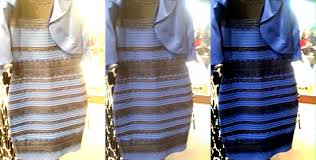
How do you see it?Back then it turned into a civil war , people polarized into 2 aggressive factions presenting the question, is it blue and black or is it white and gold?
Well , spare your scientist disguise, the mystery had long been solved . In simple terms, your brain decides whether the dress is illuminated by a blue light or by a yellowish light , if it’s illuminated by blue light ,then it’s white and gold and if it’s illuminated by yellow light ,then it’s black and blue.
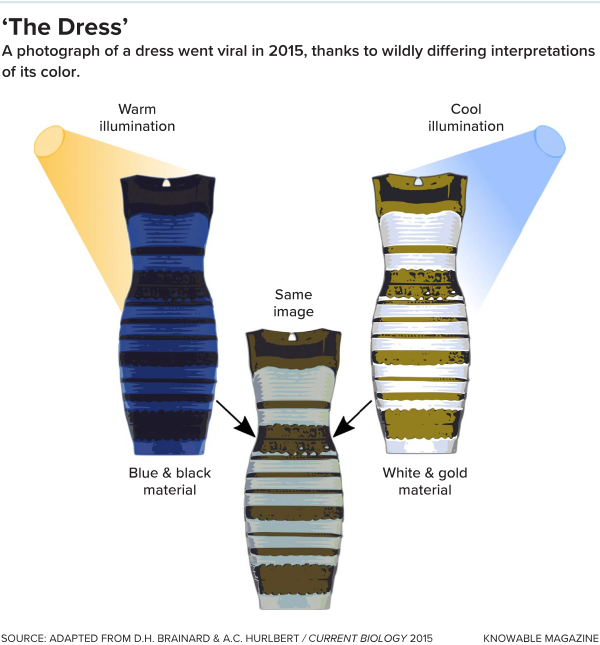
Well, that was an easy one , but what if there is another debate that -to this day- can’t really be solved ?
WELCOME FOLKS TO THE INVERTED SPECTRUM PROBLEM!
As soon as you started seeing , you’ve been taught that strawberries are red while limes are green , this is brown and that is yellow , etc…
Put your scientist disguises back on , how do we see colour? , hate to break it down to you , but objects around us don’t really have “colour” , they interact with light around them ,each object “chooses” which wavelegnths they reject(reflect back) , those “rejected” (reflected back) wavelengths hop back right into YOUR eyes.
:max_bytes(150000):strip_icc()/the-visible-light-spectrum-2699036_FINAL2-c0b0ee6f82764efdb62a1af9b9525050.png)
those rejected wavelengths go to a part of your eye called the retina , the retina has some special cells called photoreceptors made exactly for ,you guessed it ! processing light(well ,it IS more detailed than that if you wanted to look more into it) there are 2 types of photoreceptors(rods and cones), the ones we care about right now are cones , there are 3 types of cones to process 3 ranges of wavelengths(blue,green and red).

These cones send electric signals to the brain when they see the wavelengths, to the visual cortex,and that IS the true room where it happens ! there ,your brain compares the signals coming from the different types of cones to determine the specific hue. For example, a strong signal from the red cones combined with a moderate signal from the green cones gets interpreted as "yellow."
This is an incredibly complex process , since your brain also has to understand context, like how different lights affect different objects(throwback to the dress) and A LOT more !
a video to understand more
and another even more detailed video
Well , enough with the boring science talk , let’s go a few paragraphs back “As soon as you started seeing , you’ve been taught that strawberries are red while limes are green , this is brown and that is yellow , etc…” , We’ve explained the whole scientific background to how we see them-the part we can actually measure- so when you see a strawberry, wavelengths X are sent to your retina , certain cones are activated and send signals to your brain , that activate experience A in your brain , here is where it gets tricky, we have no idea how that experience is formed or how you feel it or heck even what is it!
Picture this:
When you look at a ripe strawberry (Wavelength X), your brain creates Experience A. You look at a lemon (Wavelength Y), and your brain creates Experience B. Since you were a child, everyone has pointed to strawberries and said "red," and pointed to lemons and said "green."
Now these are the rules of your brain: Experience A = "red." Experience B = "green."
Now, let's imagine your friend, We’ll call her Marissa. When Marissa looks at a ripe strawberry (Wavelength X), her brain is different. It creates Experience B. When she looks at a lemon (Wavelength Y), her brain creates Experience A. But, just like you, she was taught the names for things. Her parents pointed to strawberries and said "red," and pointed to lemons and said "green."
Now these are the rules of her brain: Experience B = "red." Experience A = "green."
You and Marissa are at a grocery store. You pick up a strawberry and say, "Wow, this is a perfect red." You are having Experience A. Marissa looks at it and says, "You're right, it is a really nice red." She is having Experience B (the exact sensation you call "green").
You would never, ever know.
WELCOME BACK FOLKS TO THE INVERTED SPECTRUM PROBLEM!
You both use the exact same words ("red," "green") for the same objects (strawberries, lemons). Your behavior is identical. But your entire internal, visual worlds are completely inverted. This is the mystery,we can't get inside anyone else's head to prove that the "red" I see is the same "red" you do,no one can really do-yep,not even scientists-, and yes, while some people may argue that -well- we’re all human,einstein! we have the same brains (physiologically) so we see / experience things(and by experience here I solely mean the brain part the same way , and …here’s the thing , we can’t really confirm that , the only way to do so is to -quite literally- be the other person which,unsurprisingly , you can’t! - -read this article for more info about how studies are changing. and also “Yet in other ways color appearance manifests as a private experience, so that, for example, the stimuli for unique hues are unique to the individual. The neural or environmental bases for these variations have yet to be revealed, but may point to fundamental principles in the visual construction of color.”(source)
At the end , I would like to know what YOU think about this subject , if you have any arguements and/or comments feel free to reach out through the contact section in homepage.
extra: see this video of a lady who can see far more colours than we do!